
|
|||||
|
As I was sitting around with some friends last night crunching some numbers, it dawned on me how boring pouring through databases as part of the content analysis section of my dissertation looked. Now, however, I’m pretty much done with the data-gathering section and now move on to the data-analysis section. Some of this too will seem boring and repetitious, but even some of the early results using just the descriptive data point out continued cause for concern for those in the newspaper industry. Indeed, this new data shows that printed newspapers will cease to exist by 2050. Continue reading Newspapers will cease to exist by 2050, data shows Since the spring of 1998, for the last 14 years, I have had the honor of editing the magazine for the national Journalism Education Association — Communication: Journalism Education Today. But to be realistic, as with any project of this magnitude, this isn’t a one-person show. People like Connie Fulkerson and Howard Spanogle have been instrumental to the magazine’s success almost since day one. The College Media Advisers, Associated Collegiate Press and College Broadcasters all met in Orlando this week. It was an intensive week for the students, advisers and Texas Rangers. At least two of the groups came out ahead. Each fall and spring as part of the convention, we host an on-site photography “shoot out.” It’s a point of pride to have the class favorite. And this fall, that recognition goes to Christopher Correa-Ortega, Valencia College (Ken Carpenter, adviser). In second place for class favorite was Ashton Bowles, Pepperdine University (Elizabeth Smith, Courtney Stallings, advisers). All 23 students who submitted work into the show collectively painted a picture of “The City Beautiful — Orlando.” Special thanks to Jim Michalowski who helped to critique the work for the students.
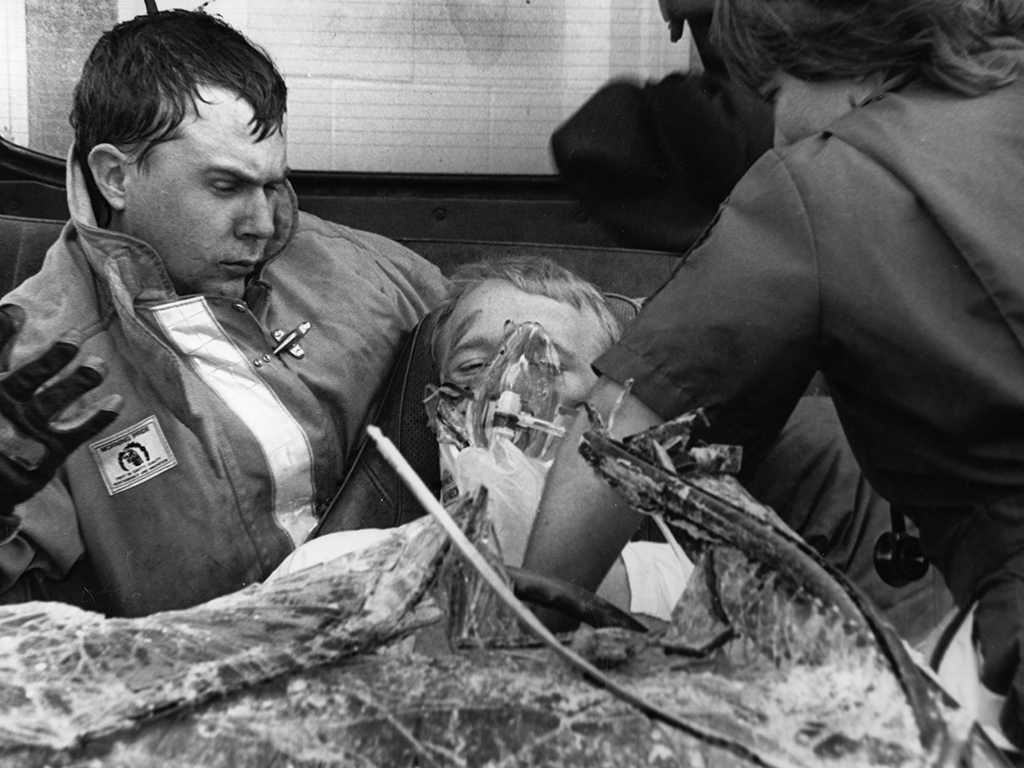
![]() Photo by Carmen Taylor/AP As we approach the 10th anniversary of the Sept. 11 attacks, everyone is taking some time for reflection. Towns are honoring their first responders. Survivors, family members and friends of those killed and thousands of others are visiting the new memorials around the country. And journalists too are spending time reflecting. For 9/11 was one of those moments that served as a reminder the power and the importance of quality, timely journalism in a time before Facebook, before Twitter and before Flickr. Cary Area EMS celebrates its 40th anniversary this year. The reason for the organization’s existence is legacy around the station. In 1971, a furniture truck struck a 4-year-old boy in Cary. Tragically, he died after waiting 45 minutes for an ambulance to arrive from Raleigh. That fall, a group of citizens met to form the Cary Area Rescue Squad, a non-profit organization designed to be independent of the local fire department, the Town of Cary and Wake County. Brent Miller, chair of the Cary Area EMS Board of Directors, said it’s extraordinary that the organization has existed for 40 years. “We’re still orange, and we’re still providing service and have been every day, every single minute for the last 40 years.”
I always spend a better part of my summer traveling around the country teaching some of the most talented high school and college students in the country. This week was no exception. I spent the first part of the week in Austin teaching at the Dow Jones News Fund Center for Editing Excellence. I’ve been doing this with great instructors like Griff Singer, the director, Beth Butler, Amy Zerba and George Sylvie for more than a decade. Then I spent the rest of the week in New Orleans at the 10th annual college yearbook workshop. I also got to spend a few minutes before I came home Sunday with a former NCSU sports editor who is entering law school this fall, Tanner Kroeger. If you ever think that America’s colleges and universities are turning out mediocre students, you haven’t met any of these folks I spent time with this week.
At his funeral in Brooklyn, April 27, family and friends of Chris Hondros remembered him as a photojournalist with a passion for documenting the lives of people in conflict all over the world. Hondros has covered many major conflicts around the world, including wars in Kosovo, Angola, Sierra Leone, Lebanon, Afghanistan, Kashmir, the West Bank, Iraq and Liberia. As Jennifer Calhoun said in her blog, “Chris knew his job covering war was important. He knew he was needed there to tell the stories. He did it well.” Father Anthony J. Sansone, who presided over the service, called Hondros a “prophetic witness,” who was able to maintain the strength and courage necessary to do his work, because of the “heart of his conscience.” Sansone said, he never ran away from reality, in his life or in his pictures, so much so that in the end it even took his life from this earth. At the service, Photography Director at Getty Images Pancho Bernasconi said, “Chris had such a good heart, even thought he saw the worst in life,” And we should all be fighting for their survival.
I have to admit right up front — I’m biased. I’m sitting here on a beautiful spring day worrying about yearbooks. Well, not about their survival, about their future. And they have a future — at least we all better hope so.
Yesterday, I went down to Columbia, S.C. for the annual Southern Interscholastic Press Association regional conference. More than 400 students came from all over the Southeastern United States to hear speakers on everything from video editing to basic reporting. It was great seeing old friends like Mark Murray, Leslie Dennis, Beth Dickey, Jake Palenske, Karen Flowers, Frank LoMonte, Chris Floore, Buck Ryan and all the others. It was great working with such talented students as T.J. Maynes who shot most of the photos in the gallery already online. And it was great teaching classes on how schools can move online efficiently and practically — now — as we went through using Facebook, Twitter, SmugMug, Flickr and other tools. Of course I always enjoy teaching my introductory photojournalism classes. Fun. There were some frustrating moments as well, every single one of them around phrases such as “I can’t…” or “The administration won’t let us….” Schools that can’t use Facebook because some administrators don’t see the value in modern social networking. Or schools that can’t use Twitter because they don’t see how it can be used in the classroom. Or, can’t use Flickr because of what students ‘might’ be able to find.
Padmé: [to Bail Organa] So this is how liberty dies… with thunderous applause.
At North Carolina State University early on the morning of Nov. 4, 2010, students stood up to protest the writing of some hateful speech on the University’s Free Expression Tunnel. One artist had drawn some art of a person with dark skin. What appears to be another artist wrote “Obama” on the wall adjacent to that art. What appears to be another artist wrote the N-word in white spray paint along with a vulgar illustration. Offensive? Yes. Hate speech? Maybe. Inappropriate? Definitely. But perhaps more disturbing to me today were the discussions about eliminating the Free Expression Tunnel completely. |
|||||
|
Copyright © 2012 Bradley Wilson - All Rights Reserved |
|||||